
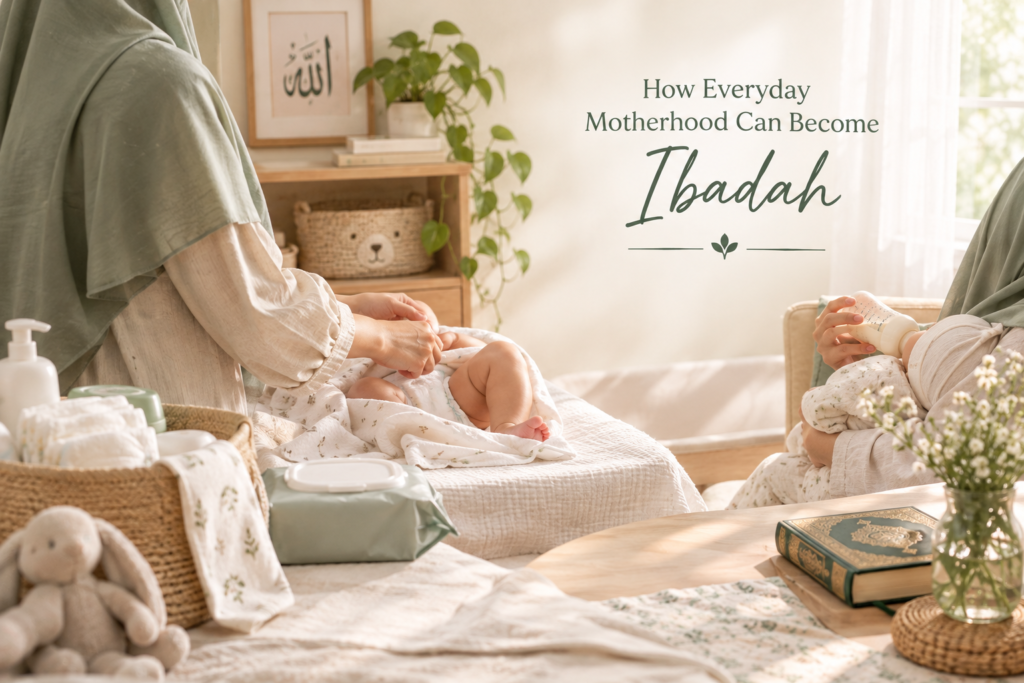
Do you ever feel like motherhood is leaving you spiritually behind while your friends are reading more Qur’an, praying more nafil salah, or spending more time in dhikr?
You are blessed with the beautiful responsibility of raising little Muslims who depend on you for almost everything. You may just need to look at motherhood from a different angle. When you begin to realize that motherhood itself can become a form of worship, even the most ordinary parts of your day can start to feel more meaningful.
You planned to read Qur’an. You wanted to pray some nafil salah, make more dhikr, or simply sit quietly and make dua. But then your baby needed you. There was feeding, changing, cleaning, cooking, crying, carrying, comforting—and another night of broken sleep.
By the end of the day, you may find yourself wondering, “I barely did any ibadah today.”
But what if you are looking at your day from the wrong angle?
What if some of the things you consider ordinary motherhood are also opportunities to worship Allah?
Motherhood does not have to be a season in which you stop growing closer to Allah. Sometimes, it is a season in which your worship simply takes a different form.
What Does Motherhood as Worship Mean?
The idea of motherhood as worship does not mean that taking care of your child replaces salah, Quran, or other acts of worship. Rather, it means recognizing that your everyday responsibilities can also become spiritually meaningful when you carry them out with a sincere intention to please Allah.
The Prophet ﷺ taught that deeds are connected to intention. He also taught that when a person spends on their family while hoping for Allah’s reward, that spending is counted as charity.
This gives mothers a beautiful way to look at their ordinary days.
You may be doing something as simple as feeding your baby, preparing food, cleaning the house, or comforting a crying child. These tasks may not look like traditional acts of worship, but when they are connected to your responsibility, love, and intention to seek Allah’s pleasure, they can become part of your journey toward Him.
The task may be ordinary. Your intention does not have to be.
You May Be Doing More Ibadah Than You Realize
Think about how much of motherhood happens without anyone noticing.
You wake up when your baby cries.
You prepare another meal.
You clean the same mess again.
You comfort your child when they are upset.
You carry them when your arms are already tired.
You teach them to say Bismillah.
You make dua for them while they sleep.
Most of these moments are not dramatic. There is no audience, no applause, and sometimes not even a “thank you.”
But Allah sees them.
When you feed your child, you can remind yourself, “Allah entrusted this little person to me, and I want to care for this amanah well.”
When you comfort your crying child, you can think, “Ya Allah, help me show mercy because You love mercy.”
When you clean your home, you can remember that you are caring for the people Allah has placed in your life.
The intention does not make every household task automatically equal to a formal act of worship. But it can give your ordinary responsibilities a spiritual purpose.
And that can change how you experience motherhood.
Motherhood Can Bring Allah Into the Smallest Moments
One of the beautiful things about motherhood is that you do not always need to find extra time to remember Allah.
You can bring dhikr and dua into the moments you already have.
While feeding your baby, remember Allah.
While walking with your child, make dua.
While preparing food, say Bismillah and thank Allah for what you have.
While putting your child to sleep, ask Allah to protect them and guide them.
While sitting beside your baby during a difficult night, remember that Allah knows exactly how tired you are.
You may not have an uninterrupted hour for worship.
But perhaps you have dozens of tiny moments throughout the day.
Motherhood teaches you that worship does not always have to happen in a perfectly quiet room.
Sometimes you connect with Allah in the middle of the noise.
What About the Nights When You Are Exhausted?
Night wakings can be especially difficult.
You finally fall asleep, and your baby cries. You get up, feed them, change them, carry them, and try to settle them again.
You may be too tired to think about anything spiritual.
And that is okay.
You do not need to force yourself to turn every difficult moment into an emotional spiritual experience.
But when you can, let your heart remember Allah.
Say Alhamdulillah.
Make a short dua.
Ask Allah to give you patience.
Ask Him to protect your child.
Even if all you can manage is a quiet “Ya Allah, help me,” that moment matters.
You are not required to pretend that exhaustion is easy. You are simply learning that even in exhaustion, you can turn toward Allah.
Raising Your Child Is Also Part of Your Amanah
Motherhood is not only about feeding, bathing, and keeping your child safe.
You are also helping shape a person.
Your child watches you pray.
They hear you say Bismillah.
They hear Alhamdulillah when you are grateful.
They see how you respond when you are frustrated.
They learn from the way you treat other people.
You do not need a perfect Islamic routine or a perfectly peaceful home to begin raising a child who knows Allah.
Sometimes Islamic upbringing starts with very small things.
You teach your child to say Bismillah before eating.
You tell them that Allah created the beautiful sky.
You make dua together.
You show them kindness.
You teach them that Muslims speak gently and help others.
These moments may seem tiny now, but childhood is built from tiny moments.
And one day, that little child may grow into an adult who remembers the simple things you taught them.
You Don’t Have to Be a Perfect Muslim Mother
Perhaps this is the most important part.
You will lose your patience sometimes.
You will have days when your home is messy, your routine falls apart, and your spiritual goals are forgotten.
There may be days when you barely manage anything beyond getting through the day.
And that is okay. Allah knows your effort, your intentions, and the struggles that nobody else sees.
Make tawbah when you need to.
Apologize when necessary.
Try again.
Motherhood is not about becoming a woman who never struggles. It is about learning to return to Allah through every season.
Sometimes your ibadah is a long prayer.
Sometimes it is a few words of dhikr while feeding your baby.
Sometimes it is choosing patience when you are exhausted.
Sometimes it is making dua over your sleeping child.
Sometimes it is finding barakah in your motherhood.
And sometimes, it may simply be doing your responsibilities sincerely while trusting that Allah sees what nobody else sees.
Your motherhood does not have to look perfect for it to be meaningful. What matters is that, through the ordinary and difficult moments, you keep turning your heart back toward Allah.
How to Make Motherhood Part of Your Ibadah
You do not need a complicated routine.
Start with one simple habit: set your intention at the beginning of the day.
Before the demands of motherhood begin, remind yourself:
“Ya Allah, this child is an amanah from You. Help me care for them with love, patience, and sincerity. Accept my efforts and make my motherhood a means of drawing closer to You.”
Then go about your day.
Feed your baby.
Change the diaper.
Prepare lunch.
Clean the kitchen.
Play with your child.
Teach them something.
Rest when you can.
Pray your obligatory salah.
Remember Allah in the little moments.
You do not have to turn every second into a religious exercise. You are simply learning to see your motherhood through a different lens.
Instead of thinking, “I did nothing for Allah today,” pause and look again.
Perhaps you cared for an amanah.
Perhaps you practiced patience.
Perhaps you taught your child something good.
Perhaps you remembered Allah in the middle of an exhausting day.
Perhaps your motherhood itself gave you dozens of opportunities to seek His pleasure.
Conclusion: Your Motherhood Can Bring You Closer to Allah
Motherhood may have changed the way you worship.
You may have less uninterrupted time. Your Quran reading may be shorter. Your nights may be broken. Your days may feel completely different from the life you had before your baby arrived.
But a changed routine does not mean a distant heart.
Motherhood can become part of your ibadah.
Not because every difficult task is automatically worship, and not because motherhood replaces your relationship with Allah, but because sincere intention can transform the way you approach the responsibilities Allah has placed in your hands.
So the next time you feel that you “did nothing for Allah” today, stop for a moment.
Look at your day again.
Your baby was fed.
Someone was comforted.
Someone was taught.
Someone was loved.
And perhaps, somewhere between the feeding, cleaning, crying, exhaustion, and little moments of joy, you remembered Allah.
That matters.
Your motherhood is not separate from your journey toward Allah.
It can be part of it.