
Have you ever looked at your baby and wondered what their life will look like one day?
Right now, your child may only need you for milk, cuddles, clean clothes, and comfort. You may spend your days feeding them, changing diapers, settling them to sleep, and trying to keep up with everything else around you.
It can feel like you are simply surviving motherhood.
But you are doing something much bigger.
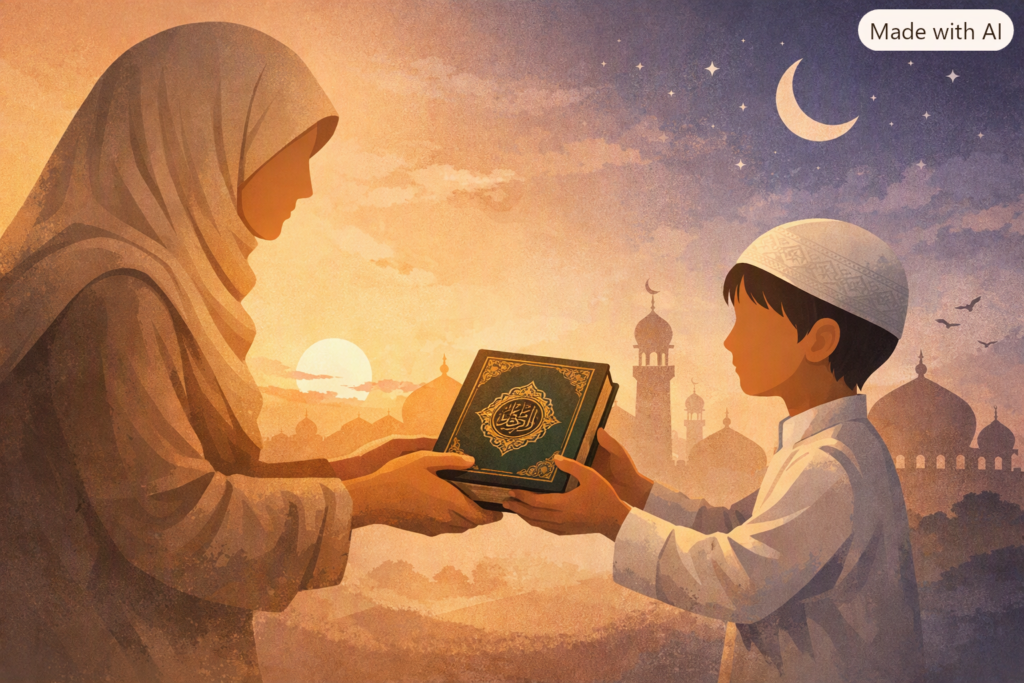
You are raising a human being who may one day become part of the Ummah that carries Islam forward.
That thought can change the way you see motherhood.
You Are Not “Just” Raising a Child
Motherhood is often described in terms of what a child needs physically: food, sleep, safety, education, healthcare, and love.
All of these things matter.
But Muslim motherhood carries another beautiful responsibility. You are also nurturing your child’s relationship with Allah, their character, their understanding of right and wrong, and their place within the Muslim community.
The Qur’an reminds believers to protect themselves and their families, placing family responsibility firmly within the life of faith.
This does not mean a mother must raise a perfect child.
It means she has been given an opportunity to plant seeds.
You may not see the tree today, but the seeds you plant in your child’s heart can grow for years.
A Mother Is Raising More Than a Baby
Your child will not always be the little person who reaches for your hand.
One day, that child may stand independently and make their own decisions. They may become a teacher, doctor, parent, community member, friend, neighbor, or someone whose kindness changes another person’s life.
And beneath all of that is the foundation they received at home.
When you teach your child to say Bismillah, you are teaching them to remember Allah.
When you teach them to say Alhamdulillah, you are teaching them gratitude.
When you teach them to be gentle with animals, share with others, speak kindly, and care about people, you are helping shape their character.
These may seem like tiny lessons.
But a person’s character is built through tiny lessons repeated over many years.
Your Sleepless Nights Have a Bigger Purpose
Motherhood can demand sacrifices that nobody sees.
There are nights when you wake up again and again.
There are days when you are physically exhausted but still have to keep going.
You may postpone your own plans because your child needs you. You may spend hours caring for someone who will not remember that particular moment when they are older.
Sometimes you may wonder, “What am I actually accomplishing?”
More than you realize.
You are caring for someone who is still being formed.
Every meal, every hug, every reminder, every bedtime story, every moment of patience, and every dua is part of the environment in which your child is growing.
Your sleepless nights are not the whole story of motherhood, but they are part of its sacrifice.
And Allah knows every sacrifice.
Your Child May One Day Carry What You Taught Them
One of the most beautiful thoughts a mother can hold is that she may never know the full impact of her parenting.
Perhaps one day your child will teach their own children Bismillah because you taught it to them.
Perhaps they will give charity because you showed them generosity.
Perhaps they will turn to Allah during hardship because they watched you make dua when life was difficult.
Perhaps they will love the Quran because they grew up hearing it in your home.
Perhaps they will help another Muslim because you taught them that caring for people matters.
You may never see all the branches that grow from the seeds you planted.
But that does not make the planting insignificant.
The Prophet ﷺ taught that after a person’s death, their deeds come to an end except for certain continuing sources of reward, including a righteous child who prays for them.
That should make a Muslim mother pause.
The child in front of you is not only someone you are raising for today.
You are nurturing a relationship that may continue to matter even after you leave this world.
The Mother Is a Child’s First Teacher
You do not need to sit your toddler down for a formal Islamic lesson every day.
Children learn from what surrounds them.
They watch you.
They hear you.
They copy you.
Your child may learn more from seeing you make salah than from hearing you explain salah.
They may understand gratitude by watching you say Alhamdulillah.
They may learn compassion when they see you care for someone who is struggling.
They may learn that Allah is near because you naturally turn to Him in your own difficult moments.
This does not mean you have to become a perfect role model before you can teach your child.
You will make mistakes.
You will lose your patience.
You will have days when your own iman feels low.
Your child does not need a flawless mother.
They need a mother who keeps returning to Allah.
That lesson itself can be powerful.
Raising the Ummah Does Not Mean Raising a Perfect Muslim
This is important.
Thinking about raising the next generation of the Ummah should inspire you, not crush you.
You cannot guarantee that your child will never make mistakes.
You cannot protect them from every hardship.
And you cannot force faith into someone’s heart.
Your role is to nurture.
To teach.
To model.
To make dua.
To create an environment where your child learns to know Allah and love what is good.
Then you trust Allah with what you cannot control.
That is where tawakkul becomes part of motherhood.
Start With the Home You Already Have
You do not need to create a perfect Islamic home overnight.
Start small.
Let your child hear Quran.
Say Bismillah naturally.
Make dua in front of them.
Talk about Allah in everyday moments.
Teach kindness.
Teach gratitude.
Teach honesty.
Let them see you apologize when you make a mistake.
Let them see that Islam is not only a list of rules but a way of living with Allah at the center.
Your home does not need to feel like a classroom.
It can simply become a place where faith is lived.
Your Motherhood Can Be Service to the Ummah
When people think about serving the Ummah, they may imagine scholars, teachers, charity workers, community leaders, or people doing visible work outside the home.
But the Ummah also needs people who are nurtured inside homes.
Before a child becomes a teacher, someone teaches them.
Before someone becomes a person who serves others, someone teaches them compassion.
Before someone becomes a person who stands firmly upon faith, someone often helps give them that foundation.
A mother’s work may be hidden, but hidden does not mean unimportant.
You may be doing some of your most important work in a room where nobody is watching.
When Motherhood Feels Small, Remember What You Are Building
There will be ordinary days.
You will wash dishes.
You will clean toys.
You will prepare food.
You will change diapers.
You will answer the same question repeatedly.
You will lose sleep.
You will wonder whether you are making any difference at all.
On those days, zoom out.
You are not only getting through another Tuesday.
You are raising a person.
You are helping shape a future Muslim.
You are nurturing values that may travel from your home into your child’s future home, friendships, work, and community.
You may never know where your influence ends.
And perhaps that is part of the beauty.
Make Dua for the Child You Are Raising
You can teach.
You can nurture.
You can model.
But ultimately, guidance belongs to Allah.
So make dua for your child often.
Ask Allah to give them iman, good character, beneficial knowledge, righteous companions, love for the Quran, and a heart that turns back to Him.
Ask Allah to make your child a source of goodness wherever they go.
And ask Allah to make you the kind of mother who helps them find their way toward Him.
Because you are not raising your child alone.
You are raising them while relying upon the One who created them.
Conclusion: You Are Planting Seeds for the Future
Your baby may be small today.
The work may feel repetitive.
Your sacrifices may feel invisible.
But motherhood is not only about getting through today.
It is also about what you are quietly building for tomorrow.
You are nurturing a child who may one day worship Allah, raise their own family, serve others, teach goodness, give charity, and contribute to the Ummah in ways you cannot yet imagine.
So when you look at your child, remember:
You are not “just” raising a child.
You are nurturing an amanah.
You are planting seeds.
You are helping shape the next generation.
And perhaps one of the greatest forms of barakah in motherhood is realizing that the little things you do today may continue to bear fruit long after you have forgotten them.
May Allah accept the hidden work of every mother, give her strength when she is tired, wisdom when she is unsure, patience when motherhood feels overwhelming, and make the children she raises a source of goodness for the Ummah.
Ameen.