
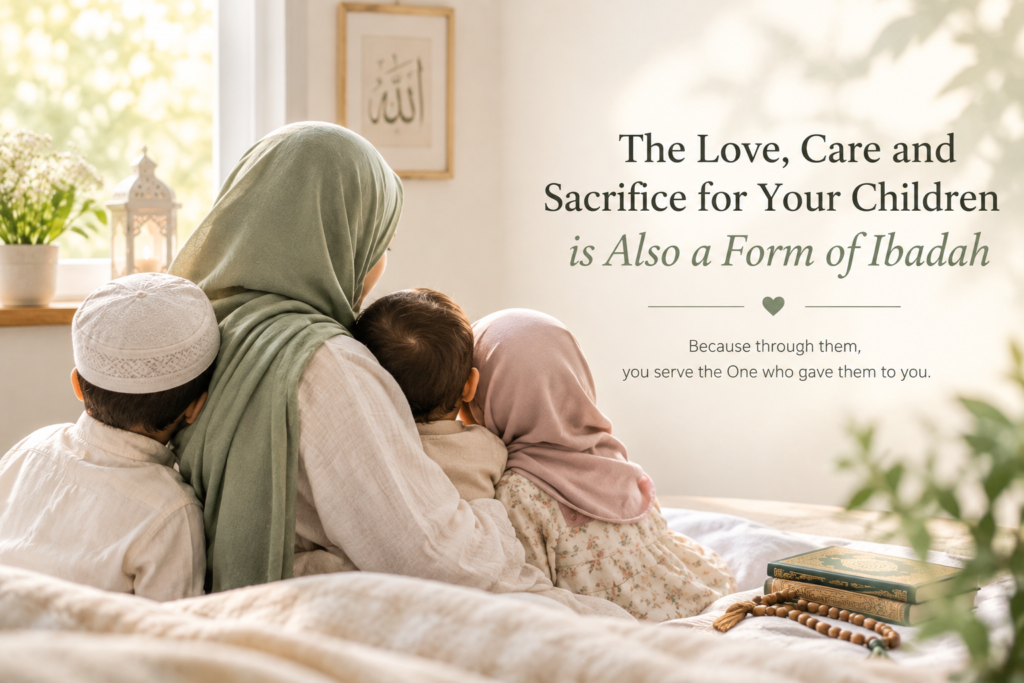
Before becoming a mother, you may have imagined getting closer to Allah through more time for salah, Qur’an, dhikr, dua, learning, and quiet moments of reflection.
Then motherhood begins.
Your nights become broken by a crying baby. Your days revolve around feeding, changing, carrying, comforting, cleaning, and trying to understand a little person who cannot yet tell you what they need.
And somewhere in all of this, you may find yourself thinking:
“Why don’t I feel as connected to Allah as I used to?”
You still want to pray. You still want to read Qur’an. You still want those peaceful moments with Allah.
But motherhood has changed what your days look like.
And perhaps the answer is not that your connection with Allah has disappeared.
Perhaps you are learning to find Him in a different kind of life.
I went through the same phase and learnt over time how motherhood brought me closer to Allah.
Your motherhood can become part of your worship
Islam does not treat caring for a child as something spiritually insignificant.
The Qur’an itself speaks about breastfeeding and the responsibilities surrounding a child. In Surah Al-Baqarah, Allah mentions mothers breastfeeding their children and reminds us that “No person is charged with more than his capacity.” — Qur’an 2:233
There is something deeply comforting in that.
Allah knows the demands of motherhood.
He knows about the nights when you barely sleep.
He knows about the baby who needs to be held when you desperately need rest.
He knows about the feeding sessions, the endless cleaning, the crying, the worrying, and the days when even finding a few uninterrupted minutes feels impossible.
And none of this means that you have stopped being a woman who wants Allah.
Your responsibilities have simply changed.
When you care for your baby with a sincere intention, show patience, protect your child’s wellbeing, and carry out the responsibility Allah has placed in your hands, those ordinary moments can become acts through which you seek His reward.
That does not mean every difficult moment automatically becomes worship without intention or effort.
Rather, it means you can bring your intention and your heart to the work already in front of you.
What about those long nights?
Maybe you wake up for the third time.
You are exhausted.
Your baby needs to be fed, changed, held, or comforted.
You wanted to pray. You wanted to read Qur’an. You wanted to wake for tahajjud.
But instead, you are sitting in the darkness with your baby in your arms.
It can feel like you did nothing for your deen that night.
But perhaps you can look at that moment differently.
You can whisper:
“Ya Allah, help me.”
You can make dua while feeding your baby.
You can remember Allah while settling your child back to sleep.
You can say dhikr while doing the repetitive tasks of motherhood.
And you can ask Allah to accept the patience, mercy, and care you are trying to give.
Islam gives enormous importance to mercy. In Al-Adab Al-Mufrad, a woman divided her own date between her two children after giving each of them one. When the Prophet ﷺ was told about what she had done, he said that Allah would show her mercy because of her mercy toward her children.
That hadith gives motherhood a beautiful spiritual perspective.
Your child does not only need your food.
Your child needs your mercy.
Your patience.
Your gentleness.
Your presence.
And Allah sees that mercy.
Motherhood teaches you sabr in places you never expected
Sabr is easy to admire when we talk about it.
Motherhood teaches you what it feels like to practice it.
Sabr when the baby will not sleep.
Sabr when you are tired.
Sabr when you planned your day and your baby had completely different plans.
Sabr when you have answered the same need for the tenth time.
Sabr when you are trying to raise your child with Islamic values while also figuring out motherhood yourself.
These moments may not look like traditional acts of ibadah.
But they can become moments in which you practice qualities that Islam deeply values.
And sometimes, motherhood exposes parts of our hearts that we did not know needed work.
It teaches us patience.
It teaches us mercy.
It teaches us humility.
It teaches us to ask Allah for help again and again.
You are not “doing nothing” because your Qur’an time is smaller
There may be seasons when you cannot sit and read several pages of Qur’an peacefully.
There may be days when your salah feels rushed because your baby needs you.
There may be nights when the worship you planned simply does not happen.
That can hurt, especially when you remember how your ibadah looked before motherhood.
If you’re also struggling with the emotional changes that can come with becoming a mother, you may relate to my own journey through postpartum and early motherhood.
But your goal does not have to be recreating your old routine immediately.
Perhaps this season requires something smaller and more sustainable.
A few verses.
A short dua.
A few moments of dhikr.
Listening to Qur’an when possible.
Making istighfar while doing household tasks.
Praying your obligatory salah and asking Allah to help you establish what you can of voluntary worship.
The point is not to measure your relationship with Allah only by how much uninterrupted time you have.
Your heart can remember Allah in the middle of ordinary life.
You are raising more than a baby
There is another part of motherhood that we sometimes overlook.
You are not simply keeping a child fed, clean, and safe.
You are helping shape a human being.
The words you repeat.
The manners you model.
The way you respond when your child cries.
The way you teach them to say Bismillah.
The way you introduce them to dua.
The way you show them mercy.
The way you teach them who Allah is.
All of these little moments become part of the environment in which your child grows.
You are helping raise the next generation of the Ummah.
And that responsibility is not small.
You do not need to raise a perfect child.
You do not need to be a perfect mother.
You need Allah’s help.
And perhaps that is one of the unexpected ways motherhood can bring you closer to Him: it constantly reminds you that you cannot do this alone.
Maybe motherhood has not taken you away from Allah
Maybe your ibadah simply looks different now.
Maybe your connection with Allah is no longer found only in quiet rooms and uninterrupted time.
Maybe it is also found in the dua you whisper while holding your baby.
In the dhikr you make while feeding.
In the patience you practice when you are exhausted.
In the mercy you show when your child needs you again.
In the moment you stop and ask Allah for strength.
Motherhood is a blessing from Allah, but it is also a responsibility.
And perhaps Allah is teaching you to turn toward Him not only during peaceful moments, but during the demanding, ordinary moments too.
So when you look back at a difficult day and think,
“I didn’t do much for my deen today,”
pause for a moment.
Perhaps you cared for someone Allah entrusted to you.
Perhaps you practiced sabr.
Perhaps you showed mercy.
Perhaps you remembered Allah between one task and another.
Perhaps you made dua with a tired heart.
Perhaps you simply kept going while asking Allah to help you.
Your motherhood does not have to compete with your deen.
With sincere intention, it can become one of the places where you live your deen.
And perhaps motherhood has not taken you further away from Allah at all.
Perhaps it is teaching you new ways to walk toward Him.
Islamic Sources
Qur’an 2:233 — regarding breastfeeding, parental responsibility, and the reminder that a person is not charged beyond their capacity.
Al-Adab Al-Mufrad 89 — regarding Allah showing mercy to a mother because of her mercy toward her children.